
WELCOME TO THE ROCKMASS WEBSITE
FOR INFORMATION AND COMMUNICATION IN THE FIELDS OF- ENGINEERING GEOLOGY
- ROCK MECHANICS
- ROCK ENGINEERING AND DESIGN
UNDERGROUND CONSTRUCTIONS: Geological uncertainties and tunnelling risks
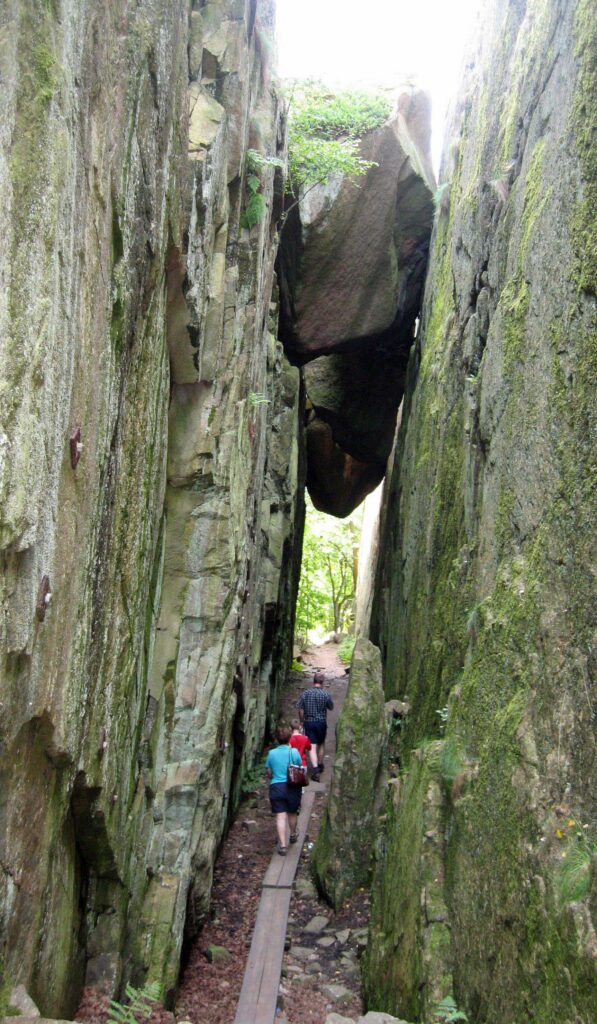
The rockmasses surrounding an underground opening form a complex structure. Risks caused by various geological features, as well as rock stresses and groundwater present challenges during construction and operation of tunnels, shafts and caverns. Prediction of the geological conditions in an underground excavation by interpretations and extrapolations from known conditions at the terrain surface may introduce considerable uncertainties.
The effect of geological uncertainties on risks can largely be reduced by applying the Observational Method, originally described by Ralph B. Peck in 1969. This method is partly used in the NATM (New Austrian Tunnelling Method). Hopefully, a refinement of this method can be included in Eurocode 7, as described in ‘Comments on Eurocode 7’.
The site presents methods, descriptions and recommendations to improved collection of geological information for application in rock engineering and design. See ‘Field observations’.
Rock engineering and classification systems
The difficulties in measuring the properties and behaviour of rockmasses, cause that simplifications are applied in description, estimates and design. An important requirement in rock engineering is that the method or tool used adequately covers the behaviour of the ground surrounding the tunnel or cavern. Rockmass classification systems play an important role here. How can such systems be applied correctly? What are the limitations?
Take a look at topics under ‘Classification and design’ to learn more about this.
Characterization and the RockMass index (RMi)
Contrary to civil engineering and mining, the quality of the construction materials (rockmasses) in underground excavations cannot be measured by strength tests, but have to be characterized by several geological parameters. As a consequence of this, the RockMass index (RMi) has been developed, with input of the parameters that have the greatest influence onrockmass strength. Being based on strength properties, the RMi values found can be used for various purposes. Take a look at topics under ‘Classification and design’ to learn more about this.
The RMi system includes more parameter inputs than most of other classification systems. The structure of RMi is, however, such that RMi can be found also when only a few parameters are found. This is shown in the Excel spreadsheets presented in ‘Estimation with RMi‘ where 4 new spreadsheet versions are shown together with a field observation scheme adapted to 3 of the spreadsheets. Also the limits of the RMi system are indicated.
Useful information on engineering geology and rock construction is presented under ‘Miscellaneous’.
“It has always seemed to me that uncertainty is the very essence of geotechnical engineering. Our materials are natural in origin, often irregular in form and highly variable in their properties. They are usually obscured from sight and can be investigated only to a small extent at great expense. The resulting uncertainty is often large and can have enormous economic consequences, . . .”
Barry K. McMahon (1985), in his Davis Memorial Lecture
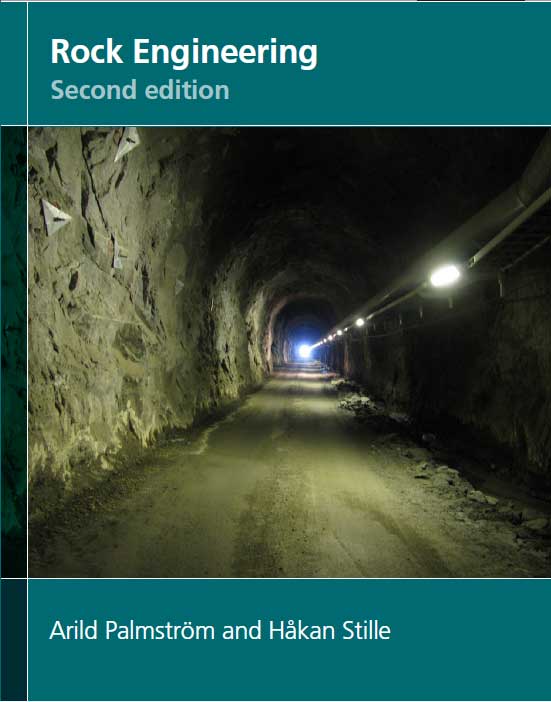
The second edition of the Rock Engineering book was published in December 2015. It is a must for those working in geo-planning of under-ground rock constructions, as it presents the use of geological data from investigations through planning to construc-tion. Proper characterization of rockmass conditions and correct use of rock engineering tools plays an important part in the book. More information can be found in Information.